Marketing operations
AI Content Repurposing Workflow
A controlled one-to-many production line for transforming an approved source into channel-ready drafts without losing facts or brand context.
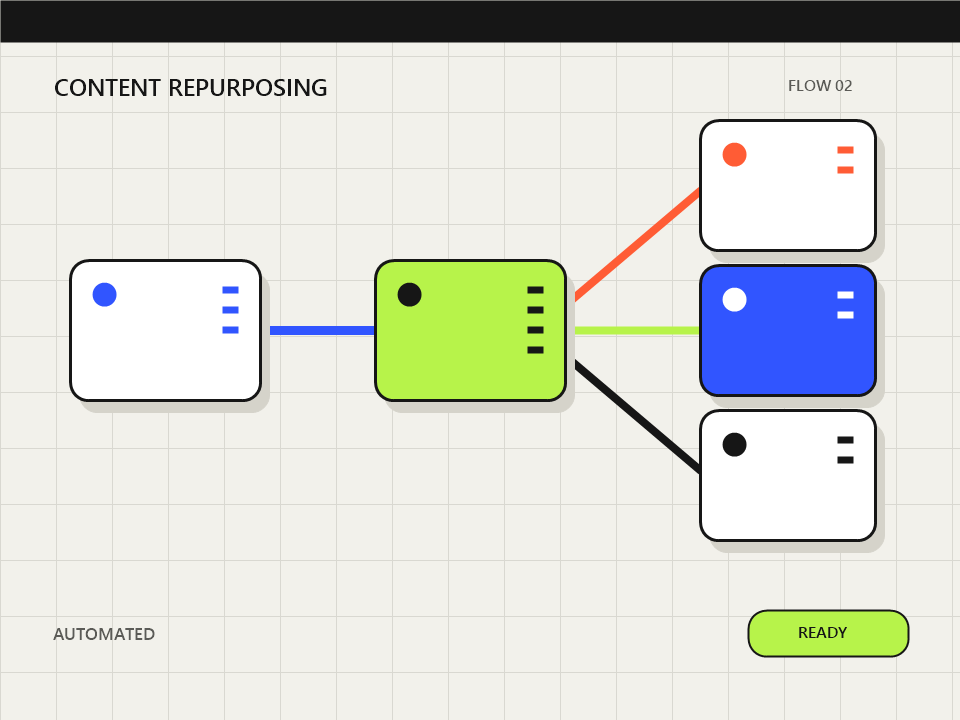
Choose one source of truth
Content repurposing fails when the workflow treats every draft, transcript, slide, and social post as equally authoritative. Start with one approved source: a published article, reviewed webinar transcript, final product briefing, or signed-off research note. The system may transform the source, but it should not invent unsupported claims to make each channel sound more exciting.
Attach source identifiers, publication date, subject owner, approved claims, forbidden claims, and expiration rules before generating outputs.
A five-stage content architecture
- Ingest the approved source
Store the final source, context, audience, campaign objective, claims, links, and usage restrictions.
- Extract reusable units
Identify key arguments, examples, quotes, proof points, objections, hooks, and calls to action without rewriting them yet.
- Transform by channel
Apply channel-specific length, structure, tone, formatting, and media requirements to the approved units.
- Review facts and brand
Compare every claim with the source, check links, remove unsupported certainty, and review sensitive or regulated language.
- Schedule and learn
Publish approved assets, record the source and version, and feed performance observations into future briefs rather than silently changing current claims.
Use a transformation matrix instead of one generic prompt
| Channel | Primary job | Control |
|---|---|---|
| LinkedIn post | One argument with professional context | Preserve source claim and link |
| Short video | Immediate hook and one payoff | No unsupported before/after claim |
| Email newsletter | Explain value to an existing audience | Match subscription expectations |
| Search article | Answer a specific query comprehensively | Unique value beyond rearranged source text |
| Sales enablement | Support a buyer conversation | Approved pricing and product language |
The matrix should define what may change and what must remain invariant. Tone and structure may change. Facts, limitations, attribution, and legal requirements should not.
Quality controls for factual and useful outputs
Require every draft to map claims back to the source. Review numbers, dates, proper nouns, quotations, URLs, pricing, and product capabilities. A draft that is fluent but adds no new value should not become a search page simply because it targets another keyword.
Use a brand rubric with observable criteria: sentence length, terminology, evidence style, prohibited exaggerations, and call-to-action rules. “Make it sound like us” is too vague to review consistently.
Implementation plan
- Select ten approved source pieces with different formats and topics.
- Define reusable units and a separate output specification for each channel.
- Generate drafts without automatic publishing.
- Record factual corrections, brand edits, and rejected outputs.
- Automate only the channel formats with stable review results.
- Keep a source-to-output ledger so claims can be corrected across every derivative asset.
Metrics that matter
Track rejected drafts, duplicated angles, link errors, and downstream conversions. Volume alone encourages the workflow to produce more material rather than more useful material.
Frequently asked questions
Should every source become every format?
No. Choose formats based on audience need and the strength of the source. Some material is unsuitable for short-form simplification.
Can the workflow publish automatically?
Only after the format has stable factual and brand review results. Regulated, contractual, or reputation-sensitive content should retain human approval.
How is this different from copying a transcript?
A good workflow extracts arguments and evidence, then rebuilds them for a new context. It does not merely shorten or rearrange sentences.
Turn this guide into your own workflow.
Use the free scenario builder to choose a function, approval model, and weekly volume.