Sales operations
AI Lead Qualification Workflow: A 5-Step Blueprint
A practical architecture for enriching, scoring, reviewing, and routing inbound leads while keeping sales decisions explainable.
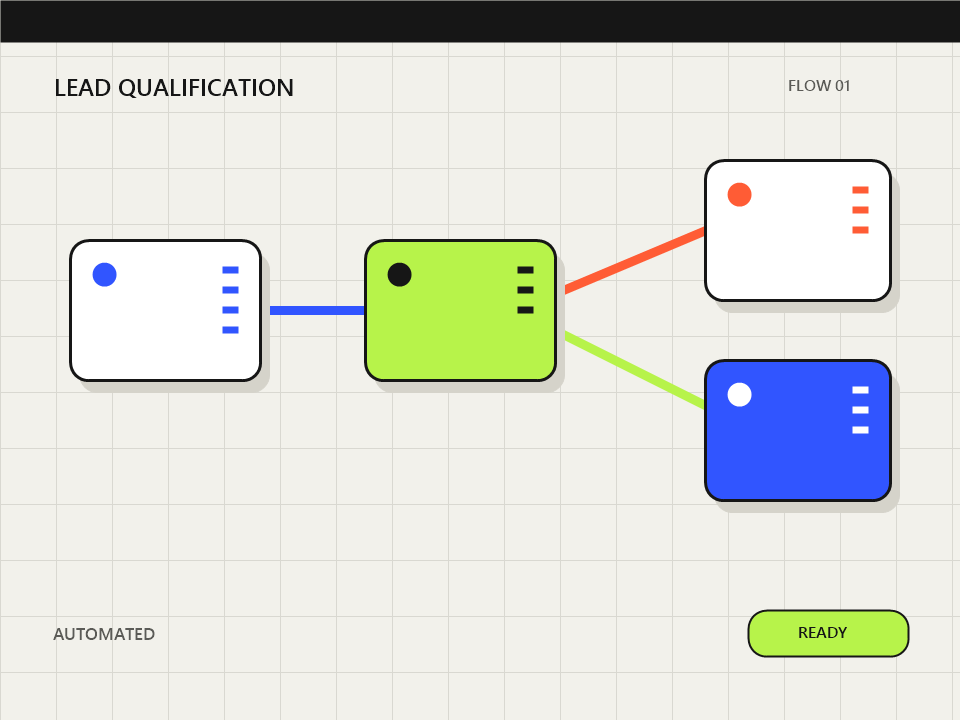
What an AI lead qualification workflow actually does
An AI lead qualification workflow is a controlled sequence that turns an inbound record into a routing decision. It should not be a black-box chatbot that decides who is valuable. A reliable system collects the original submission, adds approved context, applies explicit fit and urgency rules, sends uncertain cases to a person, and records why the lead was routed.
The workflow is useful when a team receives enough inbound leads that manual research delays the first response. It is less useful when volume is low, the sales motion is highly bespoke, or the team has not agreed on what a qualified lead means.
A five-stage architecture
- Capture the source record
Preserve the original form, email, referral source, consent state, and timestamp before enrichment changes anything.
- Enrich with approved context
Add company size, industry, location, existing account status, and other fields that are relevant to the sales policy.
- Score fit and urgency separately
Fit answers whether the account resembles a customer. Urgency answers whether the buyer shows a timely reason to act. Combining them too early makes the score difficult to explain.
- Review exceptions
Route missing data, conflicting evidence, strategic accounts, and low-confidence classifications to a named reviewer.
- Assign and record
Create the CRM owner, response deadline, recommended next step, and a compact explanation of the routing decision.
Required data and decisions
A useful workflow uses fewer fields than most teams expect. Every field should change a decision, a priority, or a message. Collecting data that never affects the workflow increases privacy risk without improving sales execution.
| Field group | Examples | Decision supported |
|---|---|---|
| Source | Campaign, referral, page, form | Attribution and response context |
| Account fit | Industry, size, geography | Territory and qualification |
| Intent | Requested outcome, timeline, product interest | Urgency and next action |
| Relationship | Existing customer, open opportunity, duplicate | Ownership and conflict prevention |
| Confidence | Missing fields, contradictory values | Automatic route or human review |
Human controls that prevent expensive mistakes
Human review should be concentrated where mistakes are costly, not placed after every routine step. A strong exception queue includes strategic accounts, possible duplicates, compliance-sensitive regions, missing consent, unusually large opportunities, and any decision below a documented confidence threshold.
Keep the scoring rules versioned. When sales leadership changes the ideal customer profile, old decisions should remain explainable under the rule set that produced them.
A staged implementation plan
- Export a representative set of recent inbound leads and label the routing decision that should have occurred.
- Write the minimum fit, urgency, exclusion, ownership, and exception rules in plain language.
- Run the workflow in shadow mode without changing CRM ownership.
- Compare recommendations with human decisions and review every disagreement.
- Automate only the stable routes; keep uncertain cases in a visible approval queue.
- Review conversion quality by source and score band each month.
Metrics and a realistic ROI model
Measure whether the workflow improves response and routing quality, not only whether it saves research time. Time saved is useful, but a faster bad decision is still a bad system.
For a starting estimate, multiply weekly lead volume by minutes of research avoided, then by four weeks and the loaded hourly cost. Subtract software and implementation costs. Treat the result as a planning range rather than a promised return.
Frequently asked questions
Should AI decide whether a lead is rejected?
Not at first. Use AI to organize evidence and recommend a route. Keep irreversible rejection or suppression rules explicit and reviewable.
Does the workflow require a predictive model?
No. Many teams obtain most of the value from deterministic routing rules plus structured extraction and enrichment.
What is the best first automation?
Duplicate detection, enrichment, owner assignment, and response deadline creation usually provide value without requiring complex scoring.
Turn this guide into your own workflow.
Use the free scenario builder to choose a function, approval model, and weekly volume.